
With the Destination Canada’s Tourism Corridor Strategy underway and the upcoming World Trails Conference proposed for October 2026 in Australia, it’s exciting to think about how trails to serve the common good for people around the world.
When I think of trails and planning, I think of the late 1960s, Systems Planning which advanced conservation land use planning through the principle of connectivity. The principle had a bioregional undertone: if we can plan with foresight and ensure that growth patterns facilitate connected continuous corridors, we the benefit the natural environment and of ‘all our relations’.
Fast forward a few decades in Ontario, and the legacy of Conservation Authorities have in large part, helped to make Open Systems Planning happen. Notably, so have many trails organizations and associations that have secured ribbons of green for the public good, like the Bruce Trail Conservancy or the Greenbelt’s Urban River Valleys. But there have also been challenges to holding the line, and as a result, there is less connectivity to natural spaces than there could have been – especially for growing communities. Take the limited accessibility to the shoreline of Lake Ontario as an example.
Yet opportunity abounds and the foresight of Open Space Systems Planning still holds water. Within this metric, if conservation is a value in land use planning; then trails are threads that bind. Trails hold a synergistic potential, weaving their way across the landscape, to achieve many things at once: protecting natural areas, providing outdoor rec, promoting alternate means of mobility and providing access to the outdoors.
More recently, trails are also serving a spaces for reconciliation in planning through Indigenous Place-Knowing. From the Great Spirit Circle Trail on Manitoulin Island, to the Ancestors Trail proposed within the upcoming Downsview Park, to the new Crane site, installed along the Credit Valley Trail at Island Lake Conservation Area, to the Indigenous installations along the Trans Canada Trail, the potential is emerging.
Trails are where people move, gather and reflect – they are excellent communal spaces for people to connect to the land, and deepen their relationship to it. In this way, they are a natural conduit for sharing the essential Treaty narrative. Treaties: the pre-constitutional documents of Canada, are the very beginning of our country, starting with the Royal Proclamation of 1763. Treaties on trails is a powerful combination.
We if can increase Indigenous presence on the landscape, through Indigenous Place-Knowing we can offer visual cues for reflection points, and thereby educate Canadians about their responsibilities as fellow Treaty people on the truth for the hope of reconciliation.
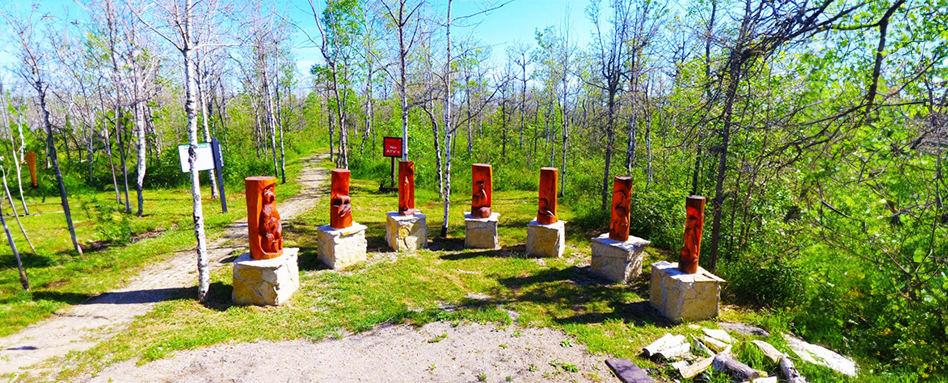
Indigenous Place Keeping Installation, Trans Canada Trail